Dental Laboratory Services: What Your Practice Should Expect From a Modern Lab Partner
Gill Sans.
Dental Technician

Table of Content
Dental laboratory services cover the design and fabrication of custom restorations prescribed by dentists: crowns, bridges, veneers, implant restorations, dentures, and appliances. A modern full-service lab combines CAD/CAM digital workflows with hand-finishing, delivering most single units in 5 to 10 business days with remake rates below 3%.
Key Takeaways
• A full-service lab handles fixed, removable, implant, and appliance work under one roof, which means fewer vendors to manage and fewer handoffs where cases go wrong.
• Going digital (intraoral scans plus CAD/CAM) cuts turnaround by 30 to 50% and takes the two biggest remake causes off the table.
• The true cost of a lab is not the unit fee. It's the remakes, the adjustment visits, the rescheduled patients.
• Vet any lab on five things: remake rate, turnaround consistency, scanner compatibility, technician access, and material traceability.
• Thinking of switching? Send one live case first. Judge the seat, not the sales pitch.
Ask any dentist about their worst week and a lab case usually shows up somewhere in the story. The crown that arrived Thursday with an open margin. The denture on its third adjustment. The patient who got rescheduled, again, because shipping ate four days nobody budgeted for.
Your lab is invisible when things go right and painfully visible when they don't. That makes choosing dental laboratory services one of the highest-leverage decisions a practice owner ever makes, and oddly, one that most of us make with very little real information. This guide covers what a full-service dental laboratory actually does, what changes when the workflow goes digital, what fair lab pricing looks like in the US and Canada right now, and how to vet a lab before you trust it with your reputation.
What Are Dental Laboratory Services?
Dental laboratory services are the design, fabrication, and finishing of custom dental restorations and appliances that a dentist prescribes but doesn't produce chairside. A dental lab receives a digital intraoral scan or physical impression, then certified technicians design and manufacture the restoration to match the patient's anatomy, occlusion, and shade before shipping it back to the practice for seating.
That's the textbook definition. In practice, the relationship goes further. A good lab calls you about a questionable margin before milling, not after. It suggests switching materials when your prep depth won't support what you prescribed. And on a full-arch case, someone actually picks up the phone. The labs worth keeping behave less like suppliers and more like a second set of clinical eyes.
What Services Does a Full-Service Dental Lab Provide?

Four categories of work, one accountable partner. That's the whole argument for a full-service laboratory:
Fixed Restorations (Crowns & Bridges)
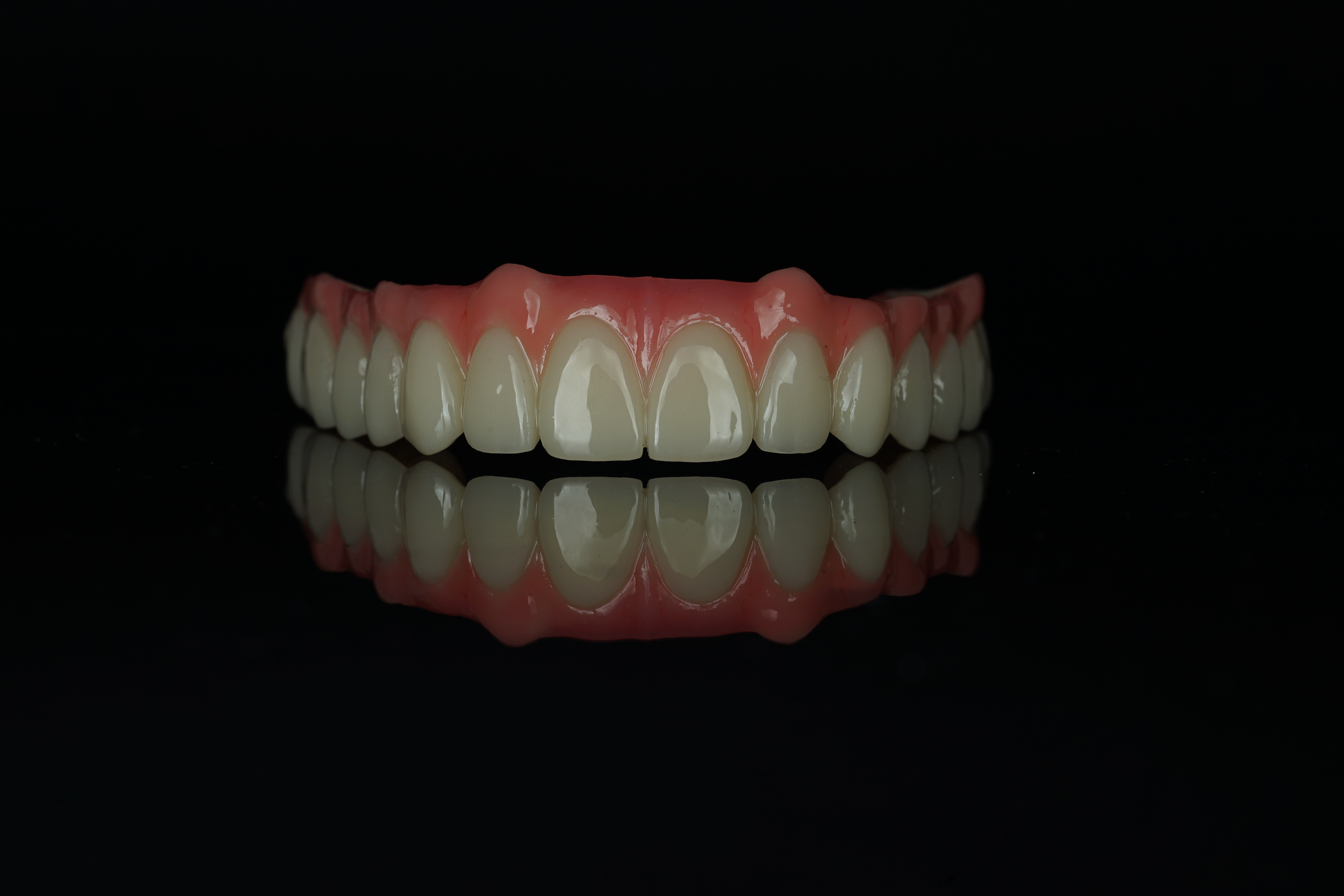
The bread and butter of most lab relationships: monolithic and layered zirconia, e.max for anterior esthetics, PFM where it still makes sense, full-cast restorations, inlays, onlays, and multi-unit bridges. Quality here comes down to a single question. Does it seat in one try? A milling machine gets you close. Careful CAD design and a technician who hand-finishes the margin get you the rest of the way.
Implant Restorations
Screw-retained and cement-retained implant crowns, custom abutments in titanium or zirconia hybrid, implant bridges, and full-arch fixed hybrid prostheses. Implant work is where communication earns its keep. Platform compatibility, emergence profile, screw access placement. All of it should be settled before design starts, not discovered at the seat with the patient in the chair.
Removable Prostheses
Complete dentures, partial dentures with cast or flexible frameworks, implant-retained overdentures, and immediate dentures. Digital denture workflows now allow labs to keep a patient's design on file, so a lost or broken denture can be reprinted without new impressions.
Appliances & Digital Services
Night guards, occlusal splints, surgical guides, custom trays, and diagnostic wax-ups. Many labs now also offer design-only services for practices that mill in-house, print models from scan files, and produce smile design previews that quietly do half the work in a case acceptance conversation.
Digital vs. Traditional Dental Lab Workflows: What Actually Changes?

A digital lab works from intraoral scan files and CAD/CAM manufacturing. A traditional lab works from physical impressions and stone models. Both can produce excellent restorations; plenty of beautiful crowns were made in 1995. What digital removes are the two biggest sources of remakes, which are impression distortion and shipping damage.
Factor
Digital Workflow
Traditional Workflow
Case Submission
Intraoral scan uploaded in minutes (STL/PLY)
Physical impression shipped 1 to 3 days
Typical crown turnaround
3 to 7 business days
7 to 14 business days
Remake risk
Lower. No impression distortion; margins verified on screen before milling
Higher. Material shrinkage, pulls, shipping damage
Design review
Dentist can approve design preview before fabrication
Not practical for routine cases
Records
Scans are stored digitally; remakes and repairs need no new impression
Stone models stored physically or discarded
Best for
Most crown & bridge, implant, and appliance work
Practices without scanners; select removable cases
No scanner yet? You're not locked out. Full-service labs run hybrid workflows every day: you ship a PVS impression, the lab scans the model on arrival, and from there your case rides the same digital pipeline as everyone else's.
How Do You Choose a Dental Laboratory? (5-Point Checklist)
Every lab website says quality. Every lab website says precision. Here's what actually separates them once you start asking questions:
1. Remake rate. Ask for the number, not the adjective. Under 3% is solid. Under 1.5% is exceptional. A lab that won't share its remake rate has answered your question anyway.
2. Turnaround consistency. A lab that delivers in six days every single time beats one that promises four and lands anywhere between four and twelve. Your scheduler books seat appointments around this number, so variance costs you more than speed does.
3. Scanner & file compatibility. Confirm they take open STL files from your scanner, whether that's iTero, 3Shape TRIOS, Medit, or Primescan. A direct portal connection is even better because nobody has to export and email files.
4. Technician access. When a full-arch case gets complicated, can you reach the person actually designing it? Or does everything route through an account manager? Direct lines prevent remakes before they exist.
5. Materials & traceability. FDA-registered materials from named manufacturers, documented case by case. If a restoration fails at year three, you want to know exactly what went into that mouth.
The lowest-risk way to evaluate any of this is embarrassingly simple: send one or two live cases before you move any volume. Check the margins under magnification. Check the occlusion at the seat. And notice how the lab communicates when you ask an awkward question mid-case.
What Do Dental Laboratory Services Cost in the US & Canada?
Lab fees vary by material, complexity, and turnaround, but here are realistic 2026 ranges for outsourced lab work in the US and Canada:
• Monolithic Zirconia Crown: $99 to $180 per unit
• E.max (lithium disilicate) Crown or Veneer: $120 to $200 per unit
• PFM Crown: $110 to $190 per unit
• Implant Crown with Custom Abutment: $200 to $450
• Complete Denture (per arch): $250 to $600
• Night Guard / Occlusal Splint: $60 to $150
A caution on comparing labs by unit price alone: a $30 cheaper crown that generates one extra adjustment visit has already erased its savings in chair time. The metric that matters is cost per successfully seated restoration. That means the unit fee plus the remake, adjustment, and rescheduling costs a lab's error rate creates.
Why Do Dental Practices Outsource Lab Work?
Even practices with a milling unit in the back room send most of their work out, and for good reason. Chairside systems handle single-unit posterior crowns well. They don't handle implant hybrids, layered anterior esthetics, or removables, and the equipment and technician skills are hard to justify inside one practice. There's also simple math: a lab spreads the cost of milling, sintering, printing, and skilled labor across thousands of cases a month. And then there's your own time. Every hour spent designing and finishing a restoration is an hour you're not producing at the chair.
The practices that get the most out of outsourcing treat the lab like a clinical partner rather than a vendor. Consistent prep and scan protocols. Photos on every shade-critical case. A five-minute call before the complex case instead of a frustrated one after it.
Why Dentists Choose Dentallab.com

Dentallab.com is a full-service dental laboratory serving dentists across the United States and Canada. Every case runs through a fully digital CAD/CAM pipeline and still gets hand-finished by a technician before it ships, with margins verified on screen before milling and checked by hand after. We accept files from all major scanners (direct portal connections for iTero and 3Shape), digitize physical impressions on arrival, and send a design preview on complex cases before anything gets milled, all with FDA-registered, documented materials. Want to try us the low-risk way? Send one case and judge the seat. Get $150 Toward Your First Case — From Single Crowns to Full-Mouth Restorations.
What Dentists Say About Dentallab.com
“[Insert verified dentist review 1: 1-2 sentences on fit/turnaround. Name, DDS, Practice, State]”
“[Insert verified dentist review 2: 1-2 sentences on communication/esthetics. Name, DDS, Practice, State]”
Final Thoughts
Your lab decides how often you apologize. That's the blunt version of everything above. Pick a partner on evidence rather than adjectives: a remake rate they'll say out loud, turnaround that actually holds, a technician you can reach when a case gets complicated, materials with a paper trail. Then hold them to it, one case at a time. Whether that partner ends up being Dentallab.com or someone else, your patients will feel the difference at the seat.
Frequently Asked Questions About Dental Laboratory Services
What does a dental laboratory do?
A dental laboratory fabricates custom restorations and appliances prescribed by dentists, including crowns, bridges, veneers, dentures, implant restorations, and night guards. Technicians work from digital scans or physical impressions to produce devices matched to each patient's anatomy, bite, and shade requirements.
How long does a dental lab take to make a crown?
Most dental labs deliver a single crown in 5 to 10 business days, including shipping. Labs with fully digital workflows can turn cases around in as little as 3 to 4 days when dentists submit intraoral scans instead of physical impressions.
How much do dental laboratory services cost?
Lab fees vary by restoration type and material. In the US, a monolithic zirconia crown typically costs a practice $99 to $180, E.max around $120 to $200, and implant crowns $200 to $450, including custom abutments. Full-arch cases and removables are quoted per case.
What is the difference between a digital and traditional dental lab?
A digital dental lab works from intraoral scan files (STL, PLY) and uses CAD/CAM design, milling, and 3D printing. A traditional lab works from physical impressions and stone models. Digital workflows reduce remakes, shorten turnaround, and eliminate impression shipping.
How do I choose a dental lab for my practice?
Evaluate five things: remake rate (under 3% is strong), turnaround consistency, scanner and file compatibility, technician communication on complex cases, and FDA-registered materials with traceability. Test a prospective lab with one or two live cases before shifting volume.
Do dental labs work with all intraoral scanners?
Most full-service digital labs accept open STL files from every major scanner, including iTero, 3Shape TRIOS, Medit, Primescan, and CEREC. Confirm whether the lab connects directly to your scanner's portal, which removes manual file exports and speeds up case submission.
What is the difference between a dental lab and an in-office mill?
An in-office mill fabricates single-unit restorations chairside from pre-made blocks, while a dental laboratory offers technician design, hand-finishing, custom shading, implant componentry, removables, and multi-unit work. Most practices with mills still route complex cases to a laboratory.
How do I send cases to a dental lab?
Digital cases upload through the lab's portal or directly from your scanner software as STL or native files, along with the Rx and photos. Physical impressions ship by courier in protective packaging. Most labs provide prepaid shipping labels and case tracking.
What certifications should a dental lab have?
Look for FDA registration, DAMAS or ISO quality systems, and Certified Dental Technicians (CDTs) on staff. Material traceability documentation per case matters as much as certificates, since it proves which FDA-registered materials actually went into each restoration.
Do dental labs offer warranties or remake policies?
Most reputable labs offer free remakes for fit or fabrication errors within a defined window, commonly 30 to 90 days, and some warranty restorations for years against material failure. Ask for the remake policy in writing
Title should be blog focus not the landing page focus
Research competitors and check the points they covered
Check the competitors word count
Use some graph/chart/table
Use some numerical value/stats
Use some focus text/quote


Your First Case, Backed by $150 Credit
Cases Submitted Digitally
62%